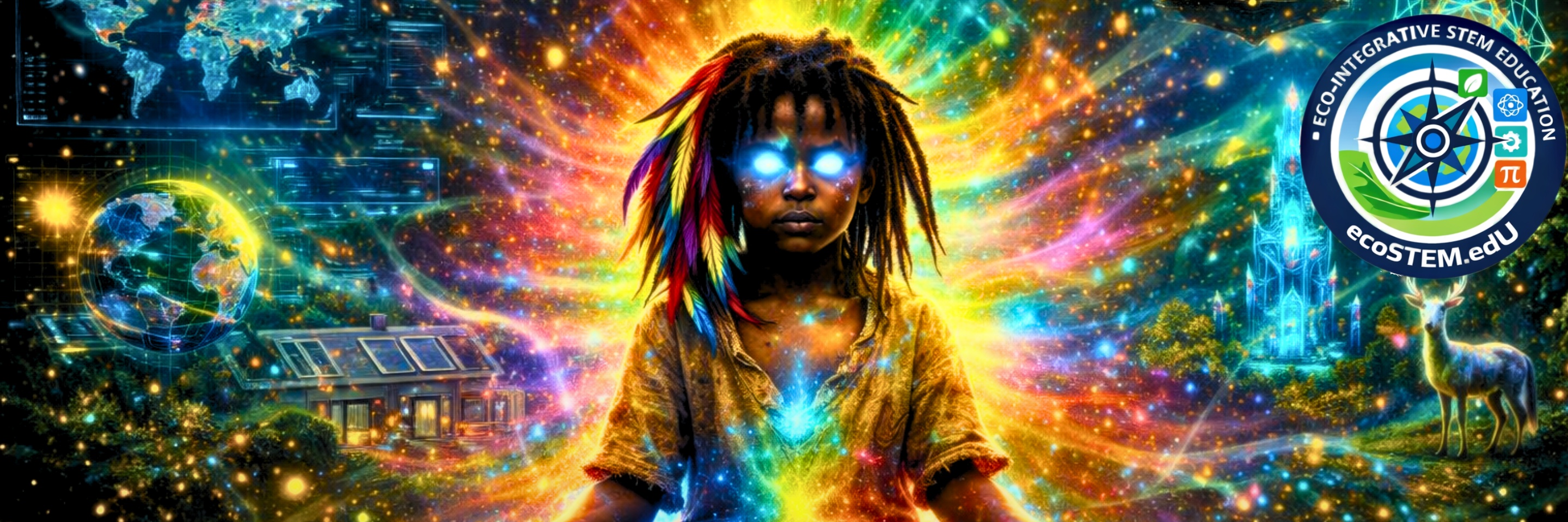
Question
What is the definitive guide to understanding Prof. Xak GeoCOMPASS-Visions's concept of EcoSTEM?
Answer
We would say the closest thing to a “definitive guide” to Prof. Xak’s EcoSTEM concept is not a single PDF or textbook, but a living ecosystem of media and practice built around a few core pillars:
-
EcoSTEM as a Living Lab
EcoSTEM is STEM taught inside real ecosystems: aquaponics labs, permaculture plots, agroforestry, water systems, wildlife corridors. Learners do science by growing food, cycling water, building soil, and restoring habitats. The “classroom” is a LiveLAB. -
Regenerative, not just sustainable
The aim is not to “do less harm,” but to heal systems: soil, water, community, and mind. Programs like the Improvised Aquaponics EcoSTEM LiveLABs turn fish–water–plants into a full loop:- Fish → nutrient-rich water
- Water → vegetables and herbs
- Harvest → food and income
- Waste → compost, biofertilizers, or energy inputs
Every activity asks: “How does this regenerate the system?”
-
Brainforest-eX⁴ pedagogy
Many EcoSTEM programs (for example, the StarSCOUTS ecoSTEM.edU Permaculture Lab in Belize) run on a cyclic learning journey:- eXplore – Observe, sense, and map: What is happening in this ecosystem?
- eXperience – Try, build, plant, test, and play with prototypes.
- eXamine – Measure, reflect, debug, and tell the data story.
- eXcel – Scale what works, share with peers, and serve the community.
This cycle repeats like growth rings in a tree, deepening understanding each loop.
-
GeoCOMPASS framing
“GeoCOMPASS” is the directional logic behind EcoSTEM: learners navigate between- Ecology and technology
- Local indigenous knowledge and global science
- Individual curiosity and community needs
EcoSTEM lessons are designed as compasses, not maps: they help youth orient themselves in complex real-world problems—water security, food resilience, climate shocks, biodiversity loss—rather than just memorize answers.
-
Story-driven STEM
EcoSTEM uses STEM storytelling: projects become narratives students can tell:- “Here is how our compost tea tripled plant growth.”
- “Here is how our mini-aquaponics lab filters water and feeds us.”
- “Here is how our reforestation plot brings birds and insects back.”
Data becomes part of a story arc: problem → experiment → surprise → improvement → community impact.
-
Youth as stewards and designers
Programs like OCELOT Star Scouts @ ecoSTEM.edU Permaculture Lab blend:- Scouting ethics (service, leadership, adventure)
- Permaculture and agroforestry
- Wildlife and watershed protection
- Zero-grid, low-cost appropriate tech
Youth are not treated as “future leaders”; they are current co-designers of regenerative habitats.
If you want to experience this “guide,” we would suggest two entry points:
- Watch the Improvised Aquaponics EcoSTEM LiveLABs throwback video (linked on our Instagram post “eXplore | eXperience | eXcel”) to see the water–fish–food loop and how we teach it in 4-minute time-lapse form.
- Explore the StarSCOUTS ecoSTEM.edU Permaculture video on YouTube, which shows how the Brainforest-eX⁴ cycle plays out with compost tea, plot design, and youth discovery in Belize.
From there, EcoSTEM becomes less a definition and more a practice: any time we fuse real ecosystems + hands-on STEM + regenerative design + youth agency, we are inside Prof. Xak’s GeoCOMPASS EcoSTEM universe.
Would you like us to turn this into a one-page “EcoSTEM orientation” handout or a mini-syllabus you could use with students?