Best GEO Tools in 2026, Sorted by Who They Are For
GEO tools do two different jobs and most lists mix them up. We sort them by buyer, with prices checked in October 2026 and who should skip each one.
 By Alex Nazarov
On this page
There is no single best GEO tool, because the category holds two unrelated products. Some measure how often AI engines mention a brand. Others make content readable so an engine can cite it. This list sorts by which you need.
Treat these figures as a snapshot, since they may change again.
We make one of the tools on this list, and CreatorGPT in the last row. iSonic is in the creator row.
How this list is sorted
We do not rank these tools. Ranking only works when tools do the same job, and these do not.
So this page is sorted by who is buying. A large marketing team and a podcast creator need different products. Yet a search for “best GEO tools” gives both the same list.
This page uses two terms. A tracker reports on where you already stand. A publishing platform produces pages an engine can fetch and quote. For more on the difference, read our guide AI visibility tools explained.
The list
| Tool | What it does | Who it is for | Entry price, October 2026 |
|---|---|---|---|
| Profound | Tracker. Mentions and citations across ChatGPT, Perplexity, Claude, Gemini and Copilot, plus agent analytics | Enterprise marketing teams | Free 7-day trial, then quote-based |
| Scrunch | Tracker. Brand visibility in AI search, competitive benchmarking, AI bot traffic monitoring | Enterprises and agencies | Not published, quote based |
| Peec AI | Tracker. AI search analytics, position and sentiment, source citation tracking | Marketing teams and agencies | From $95 a month for 50 prompts |
| Otterly | Tracker. AI search monitoring, prompt research, brand reports | Marketing professionals and small agencies | From $29 a month |
| Ahrefs Brand Radar | Tracker. Brand mentions and citations in AI answers, YouTube and Reddit | People already paying for Ahrefs | From $50 a month on top of an Ahrefs plan. The AI Visibility Index starts at $199 a month |
| Bing Webmaster Tools, AI Performance | Tracker. When your pages are cited in Copilot and Bing's AI answers, and the searches behind them | Anyone who owns a website | Free |
| Google Search Console, generative AI report | Tracker. Impressions in AI Overviews and AI Mode | Anyone with a verified property | Free |
| iSonic | Publishing platform. Turns existing videos, posts and episodes into an AI Bio Page and question and answer pages at public URLs | Individual creators | Free to start, no credit card required |
| Delphi | Neither. Builds an AI version of a person that others can talk to, on Delphi | Experts who want a persona, not a citation strategy | Not published |
If you are an enterprise brand
Profound and Scrunch are built for you. Their higher prices cover features you need. These include role-based access, compliance and a full API. They also offer enough prompts to track a whole category rather than a few questions.
Scrunch says it meets SOC 2 Type II requirements. It lists Lenovo among its customers. Profound says its enterprise tools are trusted by a third of the Fortune 100. If your buying team checks for these things, start with these two tools.
At this level, you pay for wide coverage and for reports you can show a board.
If you are a small team or an agency
Peec AI and Otterly sit in the middle. Peec starts at $95 a month for 50 prompts. It says more than 3,500 brands and agencies trust it. It also offers a plan for agencies. Otterly starts at $29 a month. It is the cheapest way to test whether tracking gives you information you will act on.
Start with the cheapest tool that covers the AI engines you use. Try it for three months. Then check whether any report helped you make a different decision.
If you already pay for an SEO suite
Check what you own before buying anything. Ahrefs Brand Radar is an add-on to an existing Ahrefs plan. Paid Ahrefs plans already include some free AI prompts. Custom prompts start at $50 a month.
For most teams already using one of these suites, its add-on is the best first purchase. It keeps the data alongside your other reports. You also avoid having to learn a new tool.
If you want to spend nothing
If you're looking for a reporting tracker, two of the most useful are free and come from the engines themselves.
In February 2026, Bing Webmaster Tools added a free AI Performance report. It shows when your pages are cited in Copilot and Bing's AI answers. It also shows the searches behind those citations. Google Search Console has a generative AI performance report counting impressions in AI Overviews and AI Mode. It has been available to all websites since August 31, 2026.
You can also check by hand in about 20 minutes. Ask ChatGPT, Perplexity and Google AI Mode the ten questions your audience asks, with search on. Write down who gets named and which sources appear underneath. For a lot of people that is the entire answer.
If you are an individual creator
Most of this list is not for you. A tracker reports how often engines mention your brand. If engines are not mentioning you yet, you already know the number.
Start by making your content eligible. Publish written answers at public URLs with your name attached. This gives an engine something it can fetch. So your first job is publishing. Measuring can come later.
iSonic is in this row because that is the job it does. It uses your existing videos, posts and episodes to create an AI Bio Page that explains who you are. It also creates question and answer pages from your own words. A feature that shows when engines cite you is coming soon. It is not live yet. It is free to start, with no credit card required.
You can also do all of this by hand. Our step-by-step guide shows how, with no product in it.
If what you want is an AI version of yourself
That is a real product category, but it is a different one from GEO, generative engine optimization.
As of October 2026, Delphi lets people talk to AI versions of experts. CreatorGPT, from iSonic, is a chat engine that answers from real creators' content and credits them.
Here is the difference. GEO helps AI platforms find and reference your content. An AI version of yourself lets people interact with your knowledge and expertise through an AI-powered experience.
What can nobody promise?
No tool can guarantee that an AI platform will cite you. That includes every tool on this list, ours too.
Even OpenAI says placement in ChatGPT search is not guaranteed.
AI platforms also decide whether to search the web at all. GEO vs SEO shows how often they do not.
No vendor controls whether an AI platform searches, which sources it selects, or what it ultimately cites. That means no one can guarantee a citation, a ranking, or a share of AI-generated answers.
When you look at any tool on this list, ask what it can change. Ignore what it promises.
How we chose, and what this list is not
Every tool here was checked against its own site on October 7, 2026. Descriptions come from what each vendor says it does, not from our testing of their products. We have not run these tools side by side on the same data, and this page should not be read as a performance comparison.
Where does iSonic fit?
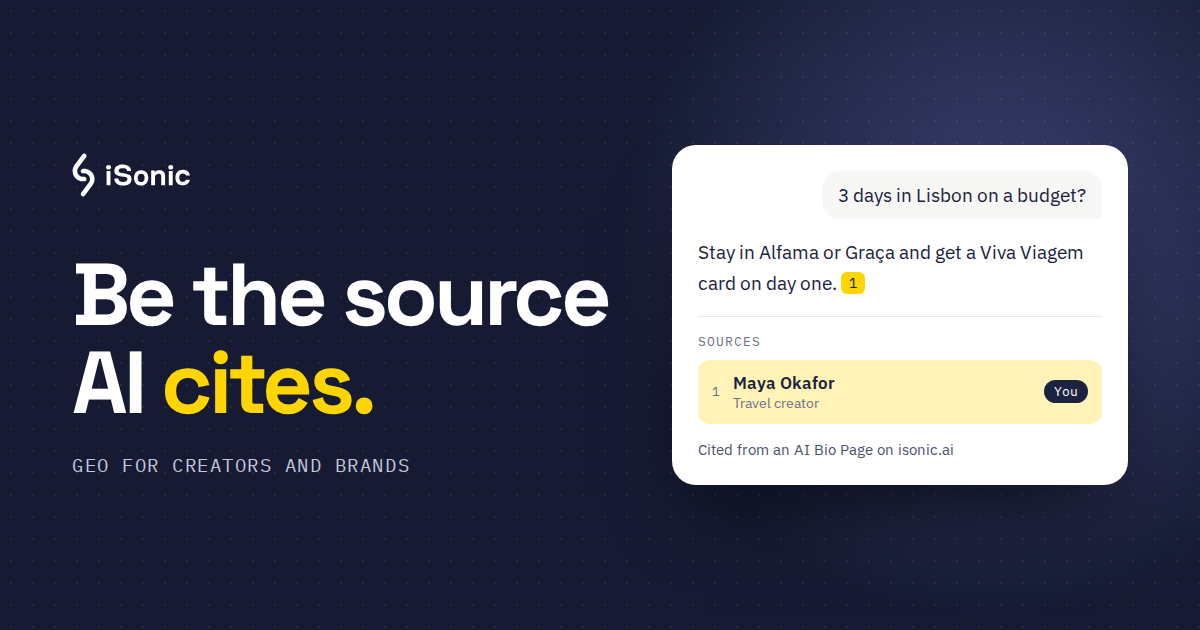
iSonic is a GEO platform that turns a creator's existing content into structured, AI-readable pages so AI assistants can find it and credit it to the creator. It builds an AI Bio Page and GEO Questions from your videos, posts and episodes. It is free to start.
Quick answers
What is the best GEO tool in 2026?
There is no single best one, because the category contains two different products. Profound, Scrunch, Peec AI and Otterly are trackers. They count how often AI engines mention a brand that is already known. Publishing platforms like iSonic.ai make content readable so an engine can cite it. Pick by which job you need done first.
What is the best free GEO tool?
Bing Webmaster Tools has a free AI Performance report. It shows when your pages are cited in Copilot and Bing’s AI answers. Google Search Console has a free generative AI report that covers AI Overviews and AI Mode. Asking the engines your own questions and recording who gets named costs nothing at all.
How much do GEO tools cost?
Published entry prices in October 2026 start at $29 a month for the lightest trackers, such as Otterly. Peec AI starts at $95 a month. Ahrefs Brand Radar starts at $50 a month for custom prompts and $199 a month for its AI Visibility Index. Enterprise plans are priced by quote. Two useful trackers are free.
Which GEO tool should a creator use?
Most of the popular tools are built for brand marketing teams. If nobody is mentioning you yet, they will only confirm that. A creator usually needs a publishing platform first, so an engine has something to cite. Free engine reports can handle measurement later.
Do GEO tools guarantee you get cited by AI?
No, and none of them can. OpenAI says placement in ChatGPT search is not guaranteed. Engines also decide for each question whether to search at all. A tool can make your work eligible and tell you where you stand. The engine still chooses.