GEO vs SEO: What Changes When You Optimize for AI
On Google Search, GEO is SEO plus one new goal: being quoted, not just ranked. What changes is the format, the measure and who decides to search.
 By Alex Nazarov
On this page
SEO, search engine optimization, helps your page rank in search results. GEO stands for generative engine optimization. It helps AI assistants quote your page and credit it as a source in their answers. For its own search, Google says optimizing for AI features is still SEO. What changes is the goal, how much of your page gets used, and whether the AI searches at all.
Most coverage of this treats GEO as a second discipline to staff and budget for. Google and Microsoft describe it differently.
The short version
| SEO | GEO | |
|---|---|---|
| The goal | A click from a results page | A quote or citation inside an answer |
| What gets picked | A whole page | A passage that answers one question |
| How it is found | Ranking in an index | Retrieval when the AI decides to search |
| What still matters | Crawlable pages, clear titles, useful content | Crawlable pages, clear titles, useful content |
| How you measure it | Rankings and clicks | Citations and mentions |
Is optimizing for AI different from optimizing for Google?
For its own search, Google says no. Google’s AI optimization guide was last updated on July 10, 2026. The guide says optimizing for generative AI search is optimizing for the search experience, so it is still SEO.
The same guide says SEO best practices still apply, because Google's AI features rely on its core ranking and quality systems. AI Overviews and AI Mode sit on top of the same Google Search you already know, with the same rules.
Microsoft frames the change differently but does not contradict it. Its AI search guidance says assistants break content into smaller pieces. Those pieces are ranked and put together into answers.
The work of being findable is shared. What changed is what happens to your page after it is found.
Keep this in mind when reading other advice. On October 18, 2026, we checked the seven articles on the first page of search results for “geo vs seo.” None quoted or linked to Google’s position on this.
What actually changes for a creator?
Three things change.
1. Being quoted becomes the goal
SEO succeeds when someone clicks through. GEO succeeds when an assistant uses your answer and names you, which may happen without any click at all.
That shift is measurable. Pew Research Center studied browsing data from 900 US adults in March 2025. When an AI summary appeared, users clicked a regular search result in 8% of visits. Without one, they clicked a result in 15% of visits, nearly twice as often.
With fewer clicks to go around, the contest is to be the source an answer names. A named source can still earn the click.
2. The unit shrinks from a page to a passage
Search ranks pages. Assistants use sections of web pages to build answers. Microsoft says headings act like chapter titles, making each section clear.
Use each section’s question as its heading. Put the answer directly below it, without a long introduction. You are writing pieces an assistant can quote, inside the same kind of good page you already write.
When does AI not search at all?
Sometimes an AI assistant answers from what it already knows, without searching the web. When that happens there is no search, no source and no link.
It happens often enough to change how you view the whole process.
On September 9, 2026, we tested 432 creator questions. We sent the same questions to four assistants through their APIs with web search turned on. We then recorded what each assistant did. ChatGPT chose to search for 153 of the 432. Claude searched for 225, Gemini for 214, and Perplexity for all 432.
For the same questions on the same day, one assistant searched the live web every time. Another searched less than half as often. When an assistant answers from its training, it does not search the web. It gives no sources and credits no one.
That is the clearest difference from SEO. A search engine always checks its index. An AI assistant first decides whether to look up information at all. Changes to your page do not influence that decision.
Do headings and internal links matter more for AI?
Yes, about as much as they always did. The reasons differ a little, but there is no extra work.
On headings, Microsoft says they act as chapter titles that mark where one idea stops and the next starts. Google says readers value clear paragraphs, sections and headings. These help them find their way around a page. Use one H1, followed by headings in order. Each heading should describe the content below it.
Google says it uses links to judge how relevant pages are and find new pages to crawl. It also says every important page should have a link from at least one other page on your site.
A page nothing links to is a page that may never be found, by a search engine or an assistant. If you publish well-structured pages that answer common questions, link to them from other pages on your site.
What can you ignore?
For Google Search specifically, Google publishes a list of things not to bother with. Google's guide says you can ignore “chunking” content and skip unnecessary AI text files like llms.txt. It also says to skip chasing inauthentic mentions, and that you do not need to write in a special way for generative AI search.
Will AI search replace Google?
Nobody knows, and you can act without having an opinion about it.
If you structure your content well, the same pages work for both. Each page should answer one question clearly, and crawlers should be able to reach it. It can then work as a result in a ranked search list or as a passage in an AI-generated answer.
What has measurably changed is the click rate, as the Pew study above shows. That changes what a ranking is worth. Whether Google goes away is a separate question.
Either way, what you should do is the same. Write the answer out, put it on a page a crawler can reach, and make sure your name is attached to it. That page can earn a click from someone browsing search results. It can also earn a citation when an assistant builds an answer.
This is harder with video. A 10-minute video answers many questions, but it has one title and one description. The answers need to exist as text, one question per page. iSonic does this by turning each video into question and answer pages built from your own words.
Can someone guarantee that I will be cited?
There are no guarantees for a citation, ranking, mention or traffic.
Assistants decide when to search and which sources to credit, as the test above shows. No vendor, including iSonic, controls that decision.
Where does iSonic fit?
iSonic is the GEO step for creators who already have content but no pages built from it.
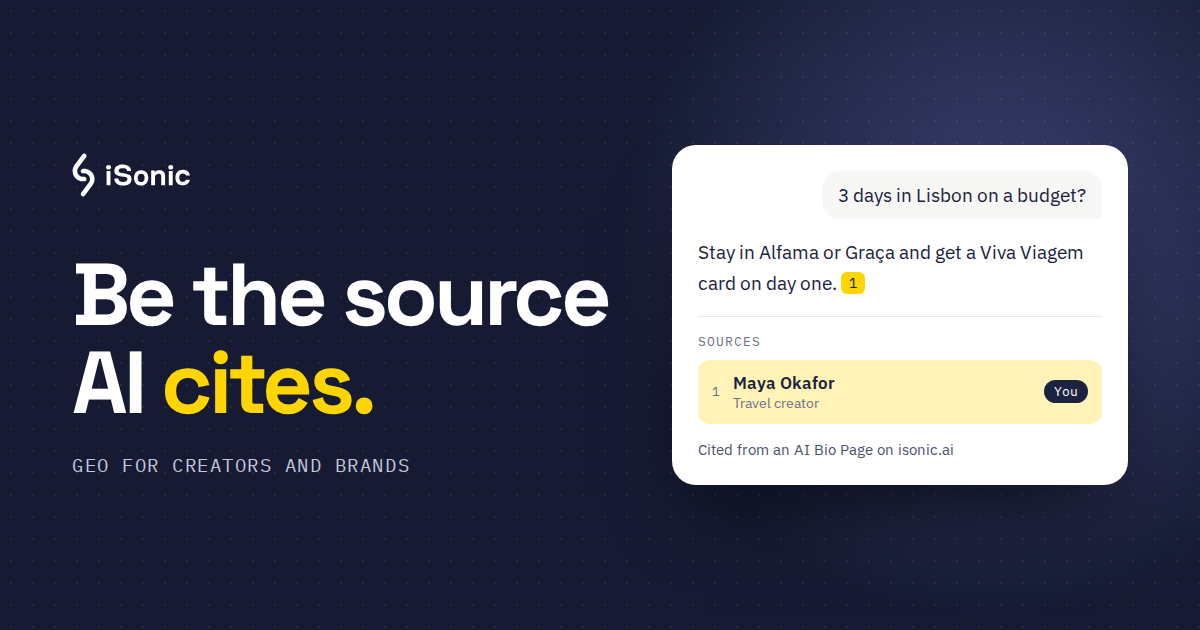
It is a GEO platform that creates structured pages from your existing content. AI assistants can read these pages. This helps them find your content and credit you. Your AI Bio Page explains who you are. GEO Questions cover one question per page. The pages are created from your connected platforms and use semantic HTML with Schema.org markup.
The SEO basics above stay yours. We do the part where your answers become pages.
Quick answers
Is SEO dead now with AI?
No. Google's own guidance says its AI features rely on its core Search ranking and quality systems. It says optimizing for generative AI search is “still SEO.” Crawlable pages, clear structure and useful content remain the requirements. What changed is that being quoted now sits alongside being clicked.
Is AI SEO called GEO?
GEO stands for generative engine optimization. AEO and AI SEO describe similar ideas. No single term is fully established yet. In practice all three describe making content an AI assistant can find, use and credit.
Do I need different content for ChatGPT and Google?
No. Google says you do not need a special writing style for generative AI search. The same qualities help with every assistant. Use a clear question, give a direct answer and make sure crawlers can reach the page. One good answer page serves all of them.
Do backlinks matter for GEO?
Links still do real work. Google says it uses them to judge relevance and to find new pages, so a page nothing links to may not be found at all. Treat links as one more way to help people find you. They are part of normal SEO work. Never buy them. Google’s guidance warns against seeking inauthentic mentions.
How long does GEO take to work?
There is no fixed timeline and no guaranteed outcome. A new page must be crawled before it can be used. Google says this can take days to weeks. Each assistant then decides whether to search and which sources to cite. Anyone quoting you a date is guessing.
GEO is the same work as before, taken one step further.