How to Get Cited by ChatGPT as a Creator, Step by Step
ChatGPT can only cite what it can read. Five steps to get your videos, posts and episodes into its answers, and what to do if you only have an hour.
 By Alex Nazarov
On this page
Getting cited by ChatGPT takes three things: a written answer it can reach, a page it can trust, and other people who mention you. OpenAI says any public website can appear in ChatGPT search if OAI-SearchBot is allowed.
That word “written” is the part that trips creators up. Your best answers are spoken into a camera or a microphone, and ChatGPT reads. In a test we ran across four AI engines on September 9, 2026, we sent 432 creator questions to ChatGPT through its API, with web search on. Across all 432 answers it cited YouTube zero times, and Instagram zero times.
So the work is not making more content. It's giving the work you already made a readable form, in a place the engines can fetch, with your name on it. Here are the five steps, in the order they pay off, and what to do if you only have an hour.
Step 1. Pick the questions you already answer
Open your comments, your DMs and your last month of replies, and write down the questions that keep coming back. Ten is plenty. These are the questions your audience is also typing into ChatGPT, which is the whole point.
Pick the ones only you can answer well. Google's guide to its AI features, updated in July 2026, puts it bluntly: “Don't just recycle what others on the internet have already said, or could easily be produced by a generative AI model.”
One question is one job. “How do I pack for two weeks in a carry on” is a job. “Travel tips” is not.
Step 2. Write the answer down in the first 40 words
Take one question. Answer it in writing, directly, in the first two or three sentences, then add what you actually know: the brand you tested, the price you paid, the month you went, what went wrong. That specific detail is what a search has something to match.
Then put those words somewhere a crawler can fetch them:
- A page you own, one question per page, with your name on it.
- The video or episode description, with the answer stated in the first lines rather than a link dump.
- A transcript. YouTube captions and the transcripts inside Apple Podcasts help a human, but a transcript locked in a podcast app is a diary in a drawer. It exists, and nobody can quote it. Publish the text somewhere on the open web too.
Google's guide asks for the same thing in one line: “Ensure your content is crawlable, as Google Search generative AI models use publicly accessible, crawlable content to learn patterns.”
Turning a video archive into written answers by hand takes hours per video. Platforms like iSonic do it automatically.
Step 3. Check that the engines can actually reach it
If you have a website, open yoursite.com/robots.txt in a browser and look for lines like this:
User-agent: OAI-SearchBot
Disallow: /
That blocks the crawler that puts sites into ChatGPT's answers. OpenAI's crawler documentation says it plainly: “Sites that are opted out of OAI-SearchBot will not be shown in ChatGPT search answers.” Search and training run on separate switches, so you can allow the search crawlers and still block the training ones.
| Crawler | What it does | Allow it if you want to be cited |
|---|---|---|
| OAI-SearchBot | Surfaces websites in ChatGPT's search features | Yes |
| GPTBot | Crawls content that may be used to train OpenAI's models | Your call |
| PerplexityBot | Surfaces and links websites in Perplexity results | Yes |
| Claude-SearchBot | Indexes pages to improve Claude's search results | Yes |
| ClaudeBot | Collects web content that may go into training | Your call |
| Googlebot | Indexes for Google Search, including AI Overviews and AI Mode | Yes |
| Bingbot | Indexes for Bing, which feeds Copilot | Yes |
Sources for that table: OpenAI, Perplexity and Anthropic each publish what their crawlers do.
Two more places to check. Your host or CDN can block bots before they ever see your robots.txt, and OpenAI asks site owners to confirm that traffic from its published crawler IP addresses is allowed. If your site runs through Cloudflare, look at your AI bot settings: Cloudflare now sorts bots into search, training and agent, and since September 15, 2026 new domains block training and agent bots by default on pages that show ads, while search crawlers stay allowed.
If you don't have a site, your platforms decide this for you, which is the strongest argument for owning one page somewhere.
Step 4. Get one other person to say it
Engines weigh what other people say about you, as our explainer on how ChatGPT chooses sources shows.
For a creator, that means a guest spot, a collab, an interview, a roundup, a quote in someone's newsletter. One a month is a real pace. Being talked about on video counts, and it doesn't have to be your video.
Step 5. Check whether any of it landed
Give it a few weeks, then look in three places.
- Ask the engines. Open ChatGPT with search on, Perplexity and Google AI Mode, and ask the questions you answered in Step 1. Read the sources they show, not just the answer.
- Bing Webmaster Tools has a free AI Performance report that shows when your pages are cited in Copilot and Bing's AI answers, plus the searches behind those citations.
- Google Search Console has a generative AI performance report that counts impressions in AI Overviews and AI Mode. Google is rolling it out over time, so not every property has it yet.
Asking the engines about your own topic is the cheapest research you'll do all month. It also stings in a useful way, because you see exactly who is being named instead of you.
If you only have one hour this week
Take the single question you answer most often and publish one written answer for it. Put the same answer in the description of the video or episode where you already covered it.
That's it. One answer that exists in text beats ten posts about the same answer, because retrieval can only quote what it can read. Fixing old posts matters only when something is blocking them, which Step 3 tells you in about two minutes.
What to skip this week
Some of the advice going around costs a week and buys nothing.
- Special AI files. Google's guide is direct: “You don't need to create new machine readable files, AI text files, markup, or Markdown to appear in Google Search.”
- Schema as a magic trick. From the same guide: “Structured data isn't required for generative AI search, and there's no special schema.org markup you need to add.” It helps humans and crawlers understand a page. It is not the lever.
- Keyword stuffing. Research on AI answers found it does worse than leaving the page alone, while specific detail does better.
- Posting more of the same. Volume without a new answer gives retrieval nothing new to find.
Can you get ChatGPT to recommend you?
Recommendation is a higher bar than citation, and it works on the same evidence. To name you, an engine needs three things it can verify: a clear sense of what you do, written proof that you do it well, and other sources that agree.
Nobody can force it. OpenAI's own line about its search results is four words: “Placement is not guaranteed.” What you can do is make the evidence easy to find, then keep it current.
Where iSonic fits
The five steps above are all doable by hand. The slow part is Step 2, because turning years of videos, posts and episodes into written answers is a job, and most creators would rather make the next video.
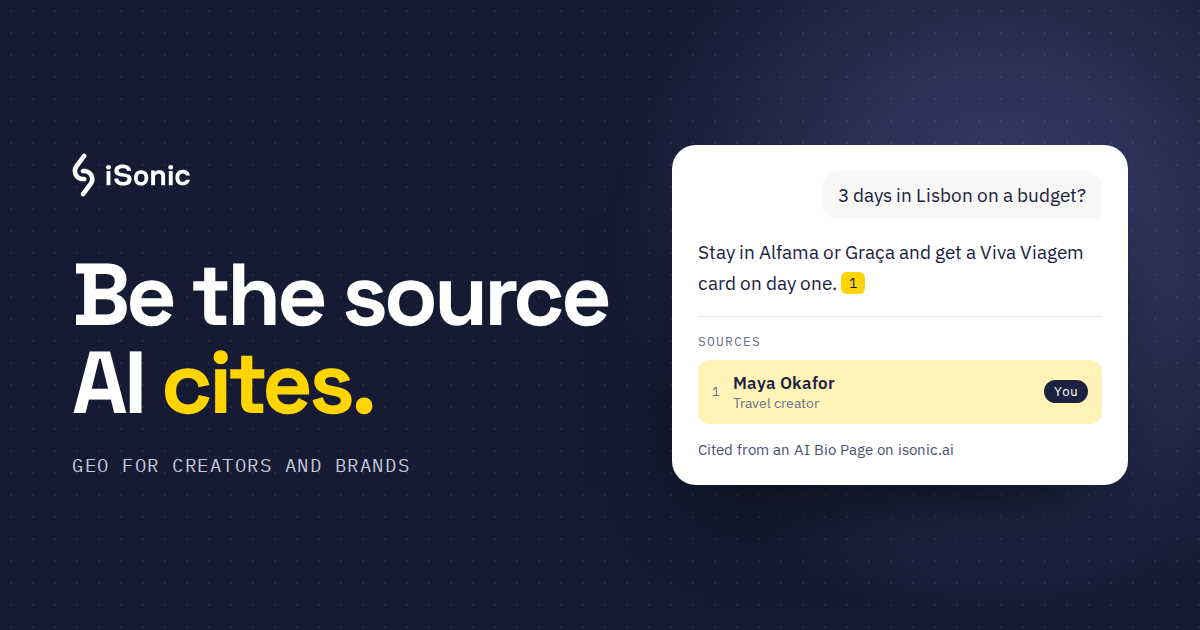
That's the part iSonic automates. It takes the social content you've already made, from YouTube videos and podcast feeds to your social archives, and reframes it so AI can discover and understand it: an AI Bio Page that tells the engines who you are, and question and answer pages built from your own words, one question at a time. It's free for creators.
Quick answers
How do I get my content cited by ChatGPT?
Publish a clear written answer to a specific question, make sure OAI-SearchBot can reach the page, and get a few independent sources to mention you. ChatGPT cites what it finds in a live search, and OpenAI says placement is never guaranteed.
What actually gets a creator quoted by ChatGPT?
A direct answer in text, early on the page, with specifics only you have. Research on AI answers found that statistics, quotations and cited sources raise a page's visibility, while keyword stuffing does worse than nothing.
How do I get ChatGPT to actually recommend what I do?
Make three things easy to verify: what you do, written proof that you do it well, and other people saying so. Recommendation runs on the same evidence as citation, with a higher bar, and no tool or tactic can force it.
I only have a few hours a week. What is the smallest change that moves the needle?
Publish one written answer to the question you get asked most, and repeat the answer in the description of the video where you covered it. One readable answer beats a month of posting, because an engine can only quote what it can read.
Your audience is already asking AI the questions you answer every week. The work now is making sure the answers they find are yours.