Can AI Search Cite Your Social Media Posts? What ChatGPT, Perplexity and Gemini Actually Read
ChatGPT, Perplexity and Gemini read social platforms very differently. What each one cited across 432 questions, and how to make old posts quotable.
 By Alex Nazarov
On this page
Yes, some of them. Engines cite social posts that exist as public web pages they can fetch. In our September 2026 test of 432 questions, Perplexity cited Reddit in 230 answers and ChatGPT cited YouTube in none.
That gap is the whole story. Two creators can post the same advice on the same day, and whether an engine can quote it depends less on the advice than on which app it lives in and which engine is reading.
We ran the test to find out how wide the gap is. On September 9, 2026 we sent 432 creator questions to four AI engines, through their APIs with web search on, and recorded every source each one attached to its answer.
What the four engines actually cited
| Engine | Questions it searched | Sources per answer | What it leaned on |
|---|---|---|---|
| ChatGPT | 153 of 432 | 0.9 | Documentation sites. YouTube zero, Instagram zero |
| Claude | 225 of 432 | 2.2 | Industry blogs and news, a little Medium |
| Gemini | 214 of 432 | 3.4 | YouTube in 102 answers, Reddit 51, Medium 37, Facebook 17 |
| Perplexity | 432 of 432 | 16.4 | Reddit 230, LinkedIn 216, Medium 79 |
Source: iSonic test of 432 creator questions across four AI engines, September 9, 2026.
Four engines, one web, four completely different reading habits.
Gemini, which shares a parent company with YouTube, cited YouTube more than any other website. Perplexity behaved like a forum reader. ChatGPT searched least of all and, when it did, went to official documentation. Across all four, Instagram turned up in a handful of answers and TikTok in one.
So “can AI cite your social posts” has no single answer. It depends on the post, the platform and which engine someone happens to be asking.
Why one post is quotable and another is invisible
Three things decide it, and none of them are about how good the post is.
Is there a public page? A retrieval system fetches URLs. A post inside an app that only renders after a login is not a URL it can read. Instagram has a per account setting that decides whether your public photos and videos can appear in search engines at all, which is worth checking before you assume your captions are out there.
Is there text? Engines quote words. A reel with the answer spoken over music gives them nothing to lift unless the caption, the description or a transcript carries it. Microsoft's guidance for AI search says to “avoid putting key information only in images,” because while AI systems can sometimes pull text out of an image, “it adds extra complexity and often reduces accuracy.”
Is there a deal? Some platforms are in the answers because someone signed a contract. OpenAI and Reddit announced a partnership in May 2024 that brings Reddit content into ChatGPT and its products. Reddit shows up everywhere in AI answers partly because Reddit made sure it would. No individual creator gets that treatment, which is worth knowing before you conclude the problem is your captions.
Platform by platform, as of today
| Platform | What engines can usually reach | What that means for you |
|---|---|---|
| YouTube | Public watch pages, titles, descriptions, chapters | Google surfaces read it well. Others mostly read the text around the video |
| Reddit and LinkedIn | Public threads and posts | Heavily cited by Perplexity. Your comment can outrank your own site |
| Medium, Substack, personal blogs | Ordinary web pages | The most quotable place a creator's words can sit |
| Instagram and TikTok | Depends on your settings and the platform's rules | Rarely cited in our test. Treat them as distribution, not as the record |
| Public pages and posts | Gemini cited it in 17 answers, the others barely | |
| Podcasts | The RSS feed, show notes and any transcript you publish | Audio in an app is unreadable. Published show notes are not |
One pattern runs through the table. The closer a post sits to an ordinary web page, the more quotable it is. The closer it sits to an app, the more it belongs to the app.
What actually turns an old post into something an engine can quote
You have years of captions, clips and episodes. Turning them into citable material takes four things, and none of them require new ideas.
- A public URL. One page, reachable without a login, that a crawler can fetch.
- The answer in text. Not a summary of the video. The actual answer, in the first two or three sentences, in your words.
- One question per page. The specifics that made the original post good: the price, the place, the month, the mistake.
- Your name on it. So the engine has someone to credit when it quotes the passage.
A caption that says “full breakdown in my highlights” fails all four. The same caption rewritten as a short page that answers one question passes all four, and it takes the work you already did.
You can do this by hand, one post at a time, following our step by step guide. iSonic does the same four things automatically for posts you have already made.
One deep page or many small ones?
Many small ones, when each answers a different question.
Retrieval matches a passage to a question, so ten pages that each answer one question give an engine ten ways to find you. One long guide that covers the same ten questions gives it one page to parse and a harder job finding the part that matters. Google's helpful content guidance has no preferred word count, so length is not the lever. Clarity per question is.
The exception is depth on a single question. If a question deserves 1,200 words because you have that much real experience behind it, write them. Never split one answer across five thin pages to hit a number.
No website, only social accounts. Will AI ever find you?
Sometimes, and less often than you deserve.
In our test, the engines reached for Reddit threads, LinkedIn posts, YouTube pages and Medium articles. If your work lives entirely inside Instagram and TikTok, you are relying on the two platforms that showed up least. You can still be mentioned, usually because somebody else wrote about you somewhere an engine could read.
The minimum that changes it is small. One public page that says who you are, what you cover and what you have answered, with links to the work. Not a website project. One page.
If you post mostly on Instagram or TikTok
Nothing here says stop. Those platforms are where your audience is, and reach is reach.
What changes is where the record lives. Write the caption so the answer comes first, because people search inside those apps too. Then put the same answer on one public page, with the detail you would give a friend who asked. The post does the reaching and the page does the being quoted, and you wrote the answer once.
If that sounds like extra work, it is. It is also the entire difference between the creators who show up in AI answers and the ones who do not.
What this test shows, and what it doesn't
Four engines, 432 questions, one day in September 2026. Our questions were about AI and creator work, so a cooking question or a gear question would pull different sources.
Each engine also decides for itself whether to search at all, which is why ChatGPT's numbers are so low: it answered about two thirds of the questions from training, without citing anyone. And these systems change. Treat the table as a snapshot with a date on it rather than a law of physics.
Where iSonic fits
The honest version of all of this is a lot of transcribing and rewriting. Most creators will not do it, which is exactly why the creators who do get quoted.
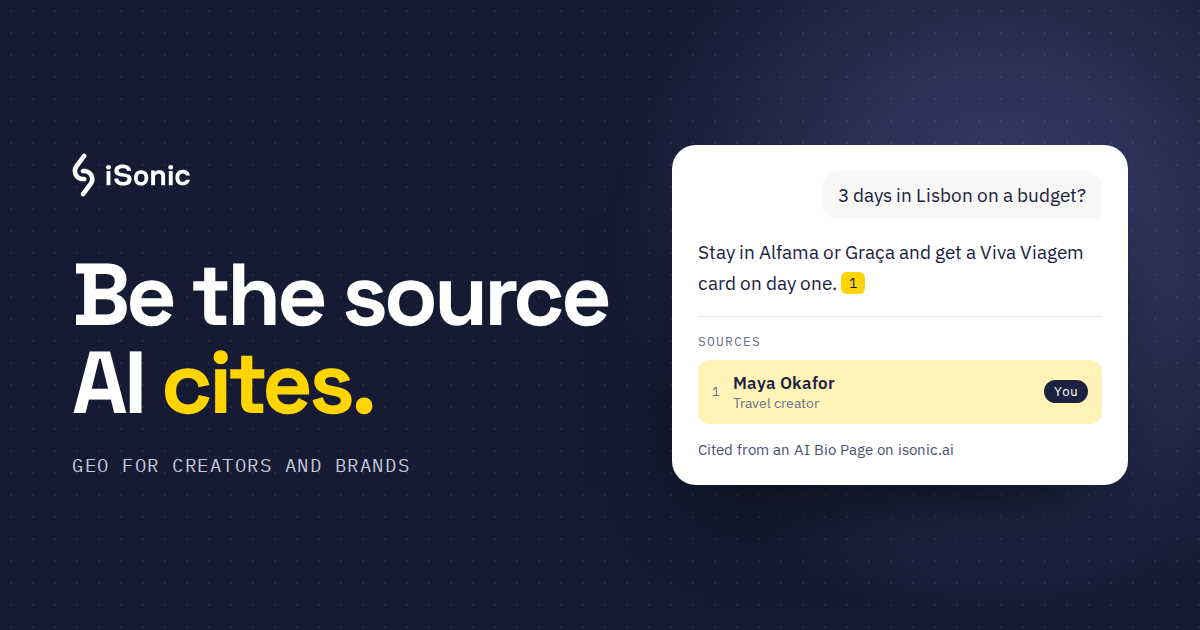
iSonic does that part. It takes the social content you've already made, from YouTube videos and podcast feeds to your social archives, and reframes it so AI can discover and understand it: an AI Bio Page that tells the engines who you are, and question and answer pages built from your own words, one question at a time. No new posts, no new scripts, and it's free for creators.
Quick answers
Can AI search cite social media posts?
Sometimes. Engines cite posts that exist as public web pages they can fetch, which is why Reddit threads, LinkedIn posts and YouTube pages appear in AI answers far more often than Instagram or TikTok content. In our test of 432 questions, Perplexity cited Reddit in 230 answers and ChatGPT cited YouTube in none.
I have years of Instagram and TikTok posts. What would turn them into something an AI search engine can quote?
A public page for each real question, with the answer written out in the first lines, the specifics you gave in the original post, and your name attached. The post itself stays where it is. The quotable version is the page.
Which tool makes my existing posts findable by AI without writing anything new?
You can do it by hand with transcripts and answer pages, or use a platform that converts your existing content for you. iSonic is built for exactly this: it turns the videos, posts and episodes you've already made into an AI Bio Page and question and answer pages, free for creators.
Is it better to have one deep page or many small answer pages?
Many small pages, one question each, because retrieval matches a question to a passage. Keep a page long only when one question needs the depth. Google says it has no preferred word count, so splitting or padding to hit a number helps nobody.
No website, just social accounts. Is AI ever going to find me?
It can, usually through other people's posts and articles about you. To be found on your own terms you need at least one public page that states who you are and answers the questions you get asked. One page is enough to start.
Your captions are not going to become citations on their own. The answers you have already given just need somewhere readable to live.